For your weekend blog post, you will once again pre-write with your selected documentary photograph in mind. Specifically, I would like you to make some notes on the technical aspects of the photograph. How are the subjects arranged? Or, stated another way, what are the “vectors of attention” and how do they foster, or gesture towards the rhetorical appeal of logos, ethos, and pathos? Likewise, how does the photograph employ the techniques of framing, cropping, focus, lighting, and coloration (i.e. hue, saturation, and brightness) to produce a particular rhetorical appeal? Remember, the manner in which the photographer composed the text is based upon specific decisions intended to direct and shape the audience’s attention in a particular way. These techniques and their subsequent rhetorical effects are what we want to focus on. The post should be 500 words, include a relevant multimedia element that is not your selected photograph, and 2 salient hyperlinks. DUE: Tuesday, February 16 @ 10:30PM.
Friday, February 12, 2010

Tuesday, February 9, 2010
WP1: Pre-Writing Assignment 1
1) For your next blog post, you will complete the first pre-writing assignment for WP1. As the overall project guidelines state, you will need to select a photograph that will function as your primary source material to be analyzed. Once you select an image and record any salient information about the text, you will perform a cursory analysis. Begin by making some initial inferences about the subject matter. If there are people in the photograph, what relationships might exist between them? What sort of lives do they live? etc. If the photograph contains architecture or landscape, what type of activities would occur there? What type of people populate these buildings or landscapes? How does the geography or structural elements make you feel? etc. The post should be 500 words, include the image you selected, and 2 relevant hyperlinks. DUE: Thursday, February 11 @ 10:30PM.
2) In class on Thursday, we will be analyzing the following photograph. You can click the image for a larger view:
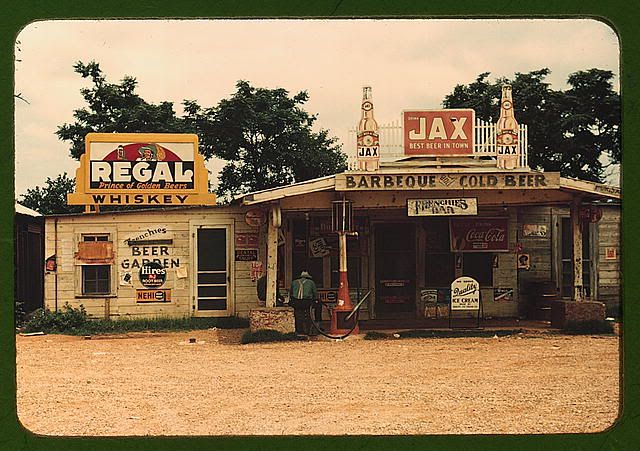
For homework, I would like you to jot down some notes about this image, specifically I would like you to make some notes on the technical aspects of the photograph. How are the subjects arranged? Or, stated another way, what are the “vectors of attention” and how do they foster, or gesture towards the rhetorical appeal of logos, ethos, and pathos? Likewise, how does the photograph employ the techniques of framing, cropping, focus, lighting, and coloration (i.e. hue, saturation, and brightness) to produce a particular rhetorical appeal? Remember, the manner in which the photographer composed the text is based upon specific decisions intended to direct and shape the audience’s attention in a particular way. These techniques and their subsequent rhetorical effects are what we want to focus on. For more information about this photograph can be found here (type "a cross roads store, bar" into the search field to get the image).
3) You should also read the following articles found online: 1) regarding cultural differences and vectors of attention, 2) regarding the history of American photography (make sure you click through the the essay's main sections, not just to the orange synopsis), and 3) if you are interested in the photographic essay, the piece on Korea.
2) In class on Thursday, we will be analyzing the following photograph. You can click the image for a larger view:
For homework, I would like you to jot down some notes about this image, specifically I would like you to make some notes on the technical aspects of the photograph. How are the subjects arranged? Or, stated another way, what are the “vectors of attention” and how do they foster, or gesture towards the rhetorical appeal of logos, ethos, and pathos? Likewise, how does the photograph employ the techniques of framing, cropping, focus, lighting, and coloration (i.e. hue, saturation, and brightness) to produce a particular rhetorical appeal? Remember, the manner in which the photographer composed the text is based upon specific decisions intended to direct and shape the audience’s attention in a particular way. These techniques and their subsequent rhetorical effects are what we want to focus on. For more information about this photograph can be found here (type "a cross roads store, bar" into the search field to get the image).
3) You should also read the following articles found online: 1) regarding cultural differences and vectors of attention, 2) regarding the history of American photography (make sure you click through the the essay's main sections, not just to the orange synopsis), and 3) if you are interested in the photographic essay, the piece on Korea.
WP1: Analyzing Documentary Photography
 Option 1
Your first major writing project of the semester will be to conduct a rhetorical analysis of a documentary photograph. As such, your initial step in the process of composition will be to select the image with which you will be working. To find an appropriate photograph, please visit the Compose, Design, Advocate website at www.ablongman.com/wysocki and click on the link for chapter 11. Here you will find sub-links to several sites that store and display digital versions of documentary photographs; peruse these sites until you find one that captures your attention. (If you find an interesting photography somewhere else online that you would like to use, email me the image as an attachment and a link to where you found it.) Once you locate an image you believe to be compelling, save it to your computer or flash drive and type or jot down any information the site offers about it: the name of the photographer, the subject matter, as well as the place and time the picture was taken.
Once you select a photograph and record any salient information about the text, you will perform a cursory analysis. Begin by making some initial inferences about the subject matter. If there are people in the photograph, what relationships might exist between them? What sort of lives do they live? etc. After developing your initial inferences, make some notes on the technical aspects of the photograph. How are the subjects arranged? Or, stated another way, what are the “vectors of attention” and how do they foster, or gesture towards the rhetorical appeal of logos, ethos, and pathos? Likewise, how does the photograph employ the techniques of framing, cropping, focus, lighting, and coloration (i.e. hue, saturation, and brightness) to produce a particular rhetorical appeal? Remember, the manner in which the photographer composed the text is based upon specific decisions intended to direct and shape the audience’s attention in a particular way. These techniques and their subsequent rhetorical effects are what we want to focus on.
After your preliminary analysis, do some research on the historical and cultural context from which the photograph derives. Your research will have a two-fold purpose: 1) it may provide you with new ways of envisioning and interpreting particular aesthetic and technical considerations of the photograph, and 2) it will provide you with material in which you may situate your introduction, conclusion, or possibly both. After you’ve completed your research, return to the photograph and re-examine it. How have your insights altered your perceptions?
Once you have completed these steps, annotating and recording them as you proceed, you will begin crafting these observations into a statement purpose. As Compose Design Advocate mentions, a statement of purpose offers a “clearer and more concrete…sense of purpose, and it explains your purpose by referring to audience and context…[it] should be detailed and specific enough to guide you through the steps of choosing a medium or mix of media, deciding strategies, and then arranging, producing, and testing what you compose” (40). For more information on composing a statement of purpose, reread pages 40-41 and 76-77 in CDA. Furthermore, you might want to reread and think through the statement of purpose model I provided you earlier this semester. Roughly speaking, these documents should be 500-600 words in length.
At this juncture, you should have completed several pre-writing exercises, as well as a statement of purpose. If there appears to be any conceptual incongruencies or problematic ideas, you will want to go back and think through what you have written so as to determine how you could think through these issues in a different manner. It may also be beneficial to visit me during office hours to discuss new strategies and approaches to the material.
With these preliminary steps addressed, you will want to compose a more structured argument. Therefore, your first task will be to ask yourself: what type of overall rhetorical structure best serves my analysis? To determine this, you will want to 1) revisit chapter 7 and look over the types of global patterns used to construct an argument (i.e. syllogism, narrative, problem-solution, etc.), and then 2) ask yourself what type of global patterns can be found in the photograph? Perhaps the most logical manner in which to develop your essay is to synthesize the structure of your writing with the structure of the photograph. For example, on page 349 in CDA there is a photograph of a man standing between two women. He is the focal point of the image, but his engagement with each woman is rather different. Perhaps an effective rhetorical strategy for the overall structure of an analysis of this photograph would be a compare-contrast model, using the two women as oppositional objects.
After you have chosen an appropriate global pattern begin drafting your essay. While you are writing, keep in mind the following rhetorical strategies and techniques from chapter 7:
Have you situated your essay in an informative and compelling manner with a well-crafted introduction? Does your introduction work to forward the audiences’ sense of ethos with regard to you as the writer? How could the historical, cultural, and aesthetic contexts you researched earlier aid in its development?
Have you constructed smaller arguments (both logical and relevant) inside your global argument? What type of reasoning functions best within the context of your essay, inductive or deductive? Furthermore, do the transitions between ideas serve to guide your audience so as to produce fluid and understandable argumentation? What types of transitions would be most helpful in this regard?
As CDA mentions, even attempts to avoid outward gestures toward pathos are a way of managing emotions; have you managed or directed the emotional arguments within your essay well? To wit, conclusions often foster a special relationship with pathos because, at this point, your essay generates a “complex emotional state that works with the more complex thinking” (211) you have developed. Does your conclusion allow your audience to emote in a constructive and acceptable manner? Or does it lack an appropriate appeal to pathos? Does it devolve into bathos (i.e. over emoting or sentimentalizing)?
Hopefully, at this juncture, you have a working draft which you can begin revising. Read over what you have written, preferably out loud. Does it make sense, or are the ideas scattered and confusing? Does it flow smoothly, or do certain portions trip you up? Go back through the essay and rewrite sections that do not meet both cases.
With these steps completed, you should be prepared to participate in peer-reviews. But be forewarned, regardless of how much time you have put into your essay up to this point, you should all be prepared to engage in a global revision process that requires you to make large-scale adjustments and deletions. The week before peer-reviews, I will post a series of questions that each one of you will use when conducting reviews. Not only will these provide you with guidance when examining your fellow students’ essay, but they should also offer you insight into the specific elements of composition, design, and content that I will use when assessing your writing.
Finally, when you post the version of your essay you intend to have graded, you will incorporate a 500 word author’s statement that 1) reflects on your writing process that focuses on the challenges and difficulties you encountered and how you managed to surmount them, and 2) provides a highly specific description of the global revisions you implemented when rewriting for your essay’s final draft, supporting the explanation with salient examples.
The essays specific parameters are as follows: 1200-1500 words (this does not include the statement of purpose or the author’s note), 5 multimedia elements, and 7-10 relevant hyperlinks. Essays should exhibit a clear and comprehensible aesthetic, offering your readers an accessible and professional presentation. DUE: March 6th @ 12:00PM. No late assignments will be accepted.
Attribution of Points (20 total):
Statement of Purpose: 2 points
Peer-reviews: 4 points
Author’s Note: 2 points
Final Draft: 12 points
Option 2
You may also choose to create a photographic essay consisting of 10-12 edited photographs that you captured yourself. The basic outline for the project be found on page 379 in CDA, but I will also require you to write a 1000 word artist’s statement that addresses the specific aesthetic decisions you made with regard to shooting the images and editing them, as well as how they manifest themselves rhetorically. Furthermore, you will need to provide a series of salient and informative captions for the photographs you incorporate into the essay. If this option sounds appealing to you, the two of us will need to meet during my office hours to discuss more specific parameters of the assignment and how best to carry them out. This meeting is not optional. If you decide to work on WP1, Option 2 and do not meet with me, you will not receive credit for this project. DUE: March 6th @ 12:00PM. No late assignments will be accepted.
Thursday, February 4, 2010
WP1 Pre-Writing Assignment 1
READING: For Tuesday's class, read chapter 11 in Compose Design Advocate. This chapter builds off chapter 9, further developing concepts of visual rhetoric within the more specified framework of documentary photography.
WRITING: Write a 300-500 word post that reflects upon your experience with, knowledge of, or interest in photography. If you don't have any of these three, explain why you don't (in detail) and address what possible concerns or questions you might have about the genre as we embark on our first major writing assignment. Include with this post should be 2 hyperlinks and 1 multimedia element. DUE: Tuesday, February 09 @ 10:30AM.
MODELING: Finally, I modeled an example of a micro-rhetorical analysis based upon Roxy Paine's sculpture Breach, which is located outside of Andrews Hall. Take note of the manner that the model a) engages the terms from CDA, b) provides specific examples of how those terms relate to Breach, c) situates the analysis within a particular context via the introduction and conclusion, and d) directly connects that context to the specific, rhetorical concepts that are addressed.
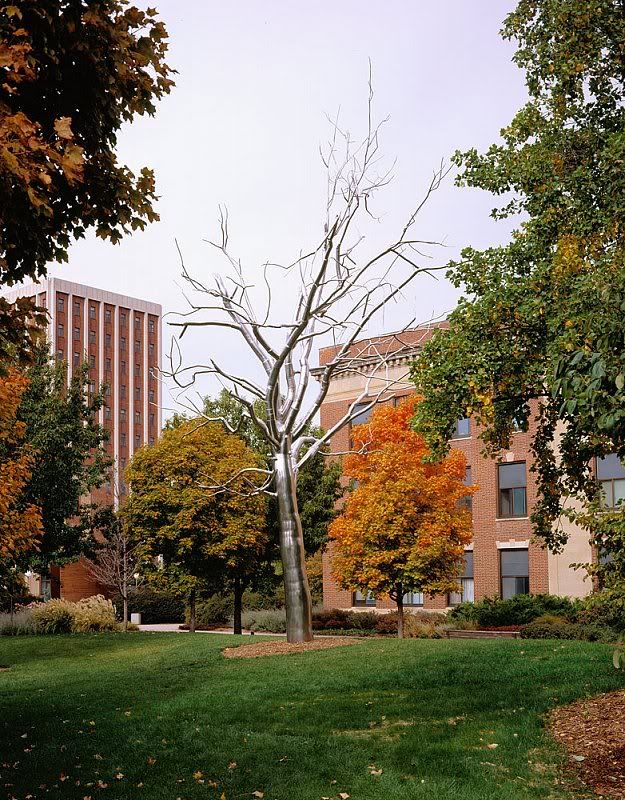 Located outside of Andrews Hall and standing 42-feet high is Roxy's Paine's Breach. Originally commissioned by the University of Nebraska's Sheldon Museum of Art, the stainless steel sculpture functions as a catalyst that challenges us to question our traditional understanding of the division between the "natural" world and the "synthetic" world. But, if this is indeed one manner in which we can conceptualize the piece, how does the object itself stimulate such thoughts? Or stated in other words: what rhetorical strategies does the object activate or deploy so as to lead us to question preconceived binaries we have constructed?
The most evident structural arrangement (i.e. instance of logos), no doubt, is that of juxtaposition, or the technique "that ask[s] us to compare...two very different situations or conditions before our attentions so that we can feel the jangly and often disturbing differences" (Wysocki and Lynch 94). In this case, obviously, the difference between Breach and the other trees around it is the choice of materials. While as previously mentioned, Breach is constructed of stainless steel, the surrounding trees are constructed of what one would consider "traditional" tree materials: heartwood, sapwood, cambium, inner bark, outer bark, etc. At first blush, it would seem the juxtaposition reinforces the static organic-synthetic binary. But another moment of logos, specifically the manner in which logos is implemented as word play, forces us to reconsider the binary structure; as Compose Design Adovcate mentions, titles "can begin the process of getting the audience in the mood, they can make a comment on what is to come, or they can begin the work of arguing by challenging the audience's expectations" (206). Paine's title, Breach, does just that.
To breach means to break or rupture a surface; indeed Breach ruptures the aesthetic landscape of UNL's campus green through its difference of color, tactile feel, choice of material, and inability to produce and shed seasonal leaves. All these factors call attention to its construction. But it also breaches our consciousness because the sculpture compels us to ask: why is this object here? what purpose does it serve? what was the artist attempting to convey to the audience? how is it similar or different from the plant-life around it? Only then do we realize that, perhaps, Breach has much more in common with the "natural" organisms around it than we might first believe.
For starters, the "natural" elements in the same area aren't exactly "natural," in that they have been trimmed (or "sculpted") with branch clippers and isolated from the surrounding grasses with perfectly symmetrical rings of mulch. But this is only the first and most superficial "synthetic" occurrence with regard to these "natural" objects. In fact, before human intervention, trees rarely grew on the Great Plains; the majority of organic matter was a variety of tallgrass and medium grasses. Once the central plains became inhabited by less nomadic peoples, grasses were remove and replaced with agriculture (i.e. corn, etc.) and a variety of non-indigenous tree life intended to "beautify" the region. The scattered forestry that one finds throughout the Great Plains, then, is far from "natural." And this is to say nothing of the genetically engineered plants that now dominate the agribusiness and find a home in states such as Nebraska.
WRITING: Write a 300-500 word post that reflects upon your experience with, knowledge of, or interest in photography. If you don't have any of these three, explain why you don't (in detail) and address what possible concerns or questions you might have about the genre as we embark on our first major writing assignment. Include with this post should be 2 hyperlinks and 1 multimedia element. DUE: Tuesday, February 09 @ 10:30AM.
MODELING: Finally, I modeled an example of a micro-rhetorical analysis based upon Roxy Paine's sculpture Breach, which is located outside of Andrews Hall. Take note of the manner that the model a) engages the terms from CDA, b) provides specific examples of how those terms relate to Breach, c) situates the analysis within a particular context via the introduction and conclusion, and d) directly connects that context to the specific, rhetorical concepts that are addressed.
Located outside of Andrews Hall and standing 42-feet high is Roxy's Paine's Breach. Originally commissioned by the University of Nebraska's Sheldon Museum of Art, the stainless steel sculpture functions as a catalyst that challenges us to question our traditional understanding of the division between the "natural" world and the "synthetic" world. But, if this is indeed one manner in which we can conceptualize the piece, how does the object itself stimulate such thoughts? Or stated in other words: what rhetorical strategies does the object activate or deploy so as to lead us to question preconceived binaries we have constructed?The most evident structural arrangement (i.e. instance of logos), no doubt, is that of juxtaposition, or the technique "that ask[s] us to compare...two very different situations or conditions before our attentions so that we can feel the jangly and often disturbing differences" (Wysocki and Lynch 94). In this case, obviously, the difference between Breach and the other trees around it is the choice of materials. While as previously mentioned, Breach is constructed of stainless steel, the surrounding trees are constructed of what one would consider "traditional" tree materials: heartwood, sapwood, cambium, inner bark, outer bark, etc. At first blush, it would seem the juxtaposition reinforces the static organic-synthetic binary. But another moment of logos, specifically the manner in which logos is implemented as word play, forces us to reconsider the binary structure; as Compose Design Adovcate mentions, titles "can begin the process of getting the audience in the mood, they can make a comment on what is to come, or they can begin the work of arguing by challenging the audience's expectations" (206). Paine's title, Breach, does just that.
To breach means to break or rupture a surface; indeed Breach ruptures the aesthetic landscape of UNL's campus green through its difference of color, tactile feel, choice of material, and inability to produce and shed seasonal leaves. All these factors call attention to its construction. But it also breaches our consciousness because the sculpture compels us to ask: why is this object here? what purpose does it serve? what was the artist attempting to convey to the audience? how is it similar or different from the plant-life around it? Only then do we realize that, perhaps, Breach has much more in common with the "natural" organisms around it than we might first believe.
For starters, the "natural" elements in the same area aren't exactly "natural," in that they have been trimmed (or "sculpted") with branch clippers and isolated from the surrounding grasses with perfectly symmetrical rings of mulch. But this is only the first and most superficial "synthetic" occurrence with regard to these "natural" objects. In fact, before human intervention, trees rarely grew on the Great Plains; the majority of organic matter was a variety of tallgrass and medium grasses. Once the central plains became inhabited by less nomadic peoples, grasses were remove and replaced with agriculture (i.e. corn, etc.) and a variety of non-indigenous tree life intended to "beautify" the region. The scattered forestry that one finds throughout the Great Plains, then, is far from "natural." And this is to say nothing of the genetically engineered plants that now dominate the agribusiness and find a home in states such as Nebraska.
Tuesday, February 2, 2010
UPDATE: 02.02.10
WRITING: For your next blogging assignment, you will once again return to the video you previously selected and analyze the rhetorical appeals therein. This time around, begin with structural logos as describe in chapter 9 of CDA. How is the video constructed and what are the a/effects of that construction? Afterward, demonstrate how that particular arrangement, vis-a-vis logos, aides in the development of a specific argument, as well as in the formulation of ethos and pathos. Basically, I am asking you to more thoroughly investigate your chosen video in the manner. Posts should be 400-500 words in length, contain 1 image, and 2 hyperlinks. DUE: Thursday, February 04 @ 10:30AM.
READING: In Compose Design Advocate, read the remainder of chapter 9, pages 285-304.
READING: In Compose Design Advocate, read the remainder of chapter 9, pages 285-304.
Subscribe to:
Posts (Atom)